By David Dodge and Duncan Kinney
Sewage, biosolids, wastewater, effluent, human waste and night soil – these are all euphemisms for poo, the waste material we produce with near certain regularity.
But instead of looking at it as a burden, as something to be disposed of, why not use it to grow a crop that can heat our buildings, produce electricity or be used for compost? Why not close the loop?
Camrose County, a small county in rural Alberta is doing just that.
If you live in even a medium sized city chances are there’s a modern facility that handles and treats all of your waste. It probably cost several million dollars and employs quite a few people. Small towns, villages and hamlets don’t have that luxury. About 90 per cent of rural municipalities use lagoon systems to treat their wastewater. These are open ponds that are aerated on a regular basis and microbes and tiny invertebrates end up eating the poop and cleaning the water.
As you can imagine these lagoons aren’t the most popular neighbours.
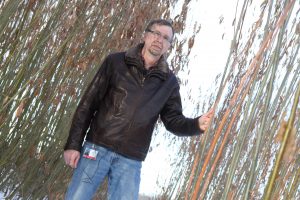
Richard Krygier, biomass specialist with the Canadian Forest Service is working with Camrose county on their waste to willows biomass project. He is standing in an experimental plantation at the Northern Forest Research Centre in Edmonton. Photo David Dodge
Richard Krygier has spent the last six years working on ways to treat this waste – not with some fancy new whiz-bang process, but with not much more than an irrigation system and a dense stand of willow trees. It’s a low cost, appropriate technology for the problem.
“I’ve heard stories from some municipalities that they know where the water is on the stream after they start discharging the lagoon because they get phone calls about the odour as the water moves downstream,” says Krygier.
It’s more than just smell, a poorly run lagoon system can have a major effect on the environment. If the wastewater isn’t treated properly and discharged into a nearby waterway serious ecological damage and costs can mount. One such community had a fish kill after a discharge.
“It cost them $50,000 in fines and $1.5 million to upgrade their lagoons in order to meet discharge standards. We could have used that money to put in a willow plantation and they wouldn’t have had to discharge again.”
Willow as super tree
The willow is a bit of super tree. They are prolific growers and can gain up to two meters of height in a single year. They’re simple to grow – just stick a cutting in the ground and you’re good to go. They thrive in moist soil and don’t mind Canadian winters. The best part is that you can cut the willows near the base and they regrow just as vigorously. This is called coppicing.
These willows are planted in dense stands near waste lagoons. The wastewater is pumped into the stand via surface or subsurface irrigation lines. Then they grow like weeds. That’s it.
These stands provide a visual barrier for the sewage lagoons while also giving a bit of habitat for birds and insects. The roots also increases soil carbon. When I was visiting one of these stands I spotted a snowy owl hanging out on a nearby pole and a flock of snow buntings flitting about the adjacent fields.
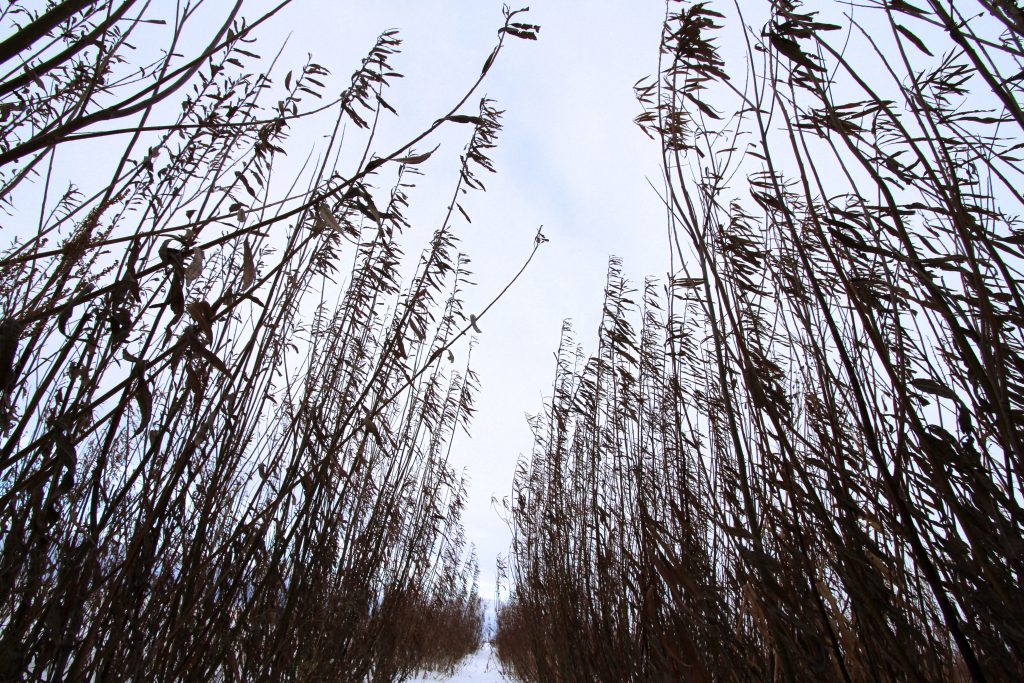
The willow plantation at the Ohaton sewage lagoon is designed to help treat sewage and provide biomass for heating. Photo David Dodge
The Biomass Potential of Willow
It’s pretty cool that small municipalities and counties now have a low tech, environmentally friendly way to deal with their sewage, but what to do with the fast growing willows?
Since the willows are coppiceable you can harvest it every three years and then burn it in for either heat or power or mulch it for compost. Camrose replaced their natural gas boilers with a biomass heating system and are using their willows and other waste wood streams to heat their main county office. They’re essentially growing and harvesting a replacement for natural gas.
Camrose County has about 8,000 people and is an hour and fifteen minutes southeast of Edmonton, Alberta. Steven Gerlitz is the county administrator and he worked with Richard Krygier to put in the willow stand and then install a biomass boiler system for his office building.
The willow stand is near the lagoon that services the hamlet of Ohaton, population 300.
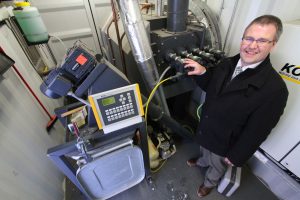
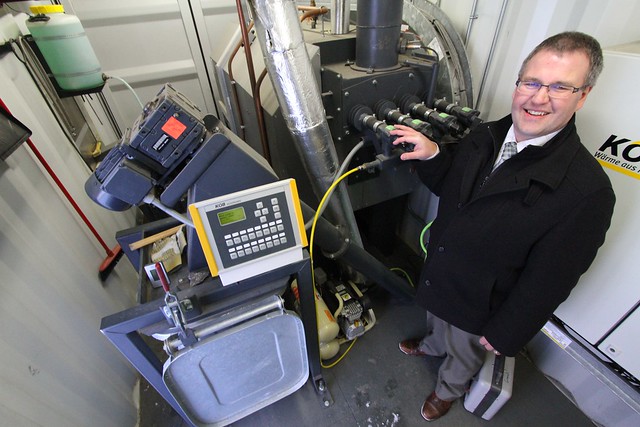
Steve Gerlitz shows off the wood chip biomass boiler, located in a sea can container just outside of the county offices in Camrose, Alberta. Photo David Dodge
Gertliz ended up replacing two aging natural gas boilers running at 55 per cent efficiency with a brand new biomass boiler from Germany at a cost of $209,000. The other cost for the project was the land that had to be purchased for the willow stand – that came to $153,000 for 17 acres. It turns out land next to these waste lagoons isn’t too expensive.
“We’re not discharging [wastewater] into the environment any more. At our system out in Ohaton the discharge actually goes into Driedmeat Lake Creek,” says Gerlitz. Driedmeat Lake Creek winds up going into Driedmeat Lake, which is the water source for the city of Camrose.
These biomass projects are considered carbon-neutral. While wood is burned and carbon dioxide is being released, carbon is also stored in the willow as it grows back. The willow stand is expected to be productive for 25 years.
The whole process started in 2007 when the county council challenged Gerlitz and his staff to come up with projects that would both help the environment and save the county money. They no longer have to worry about upgrading the Ohaton lagoon or fouling their only source of drinking water. According to Gerlitz, the simple payback (not counting opportunity and other costs) is between 7–20 years (depending on the price of natural gas).
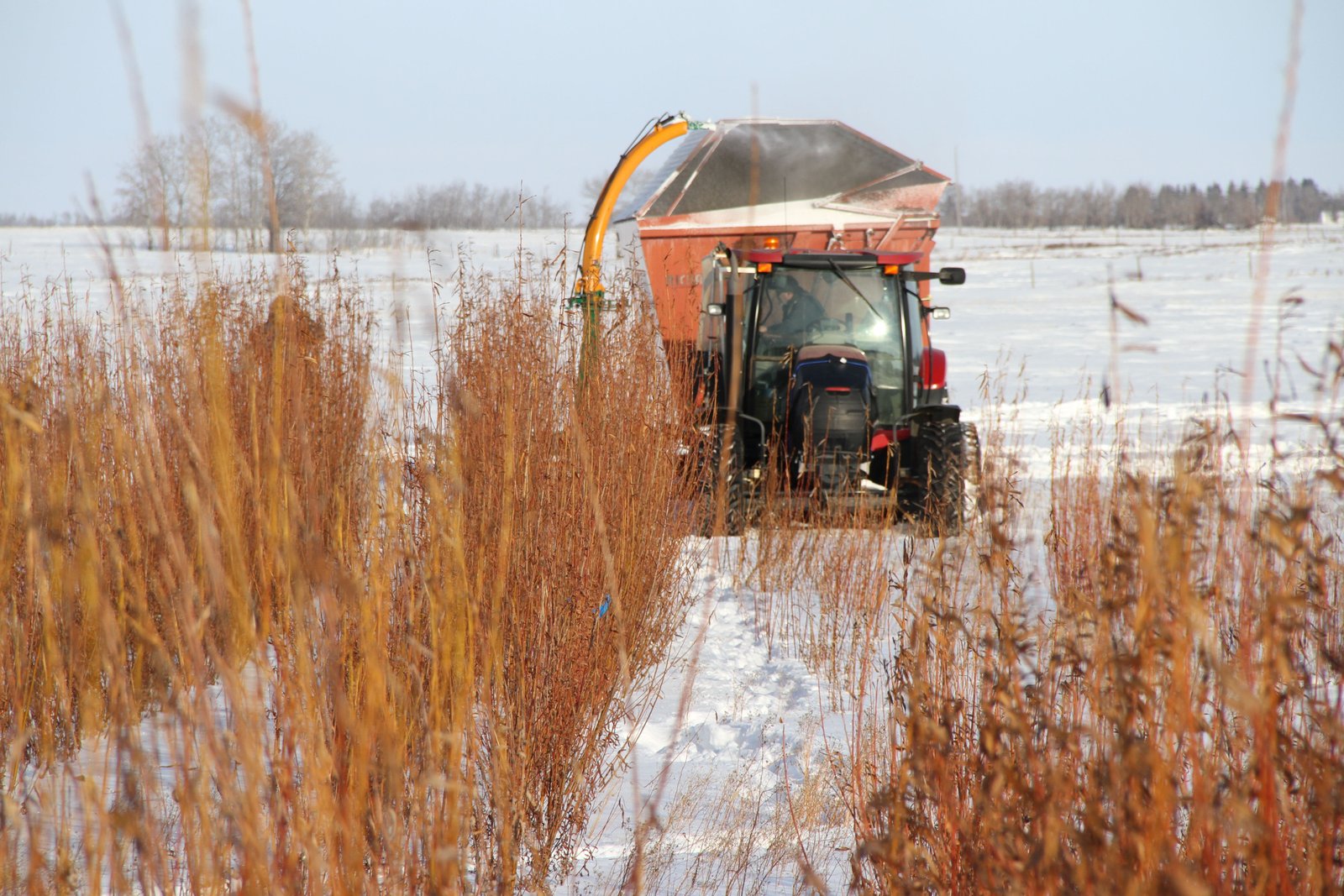
Camrose County uses local waste wood from road brushing programs and waste wood collected at two local landfills to feed their biomass boiler and they intend to use the sustainable supply of willows to top up their supply of biomass. The county is also buying some wood chips as well. They harvested their first willow crop in early January of this year.
Gerlitz has got big plans. While they’re planning to expand the Ohaton site they also have nine other hamlets that can be served by these systems. If everything goes right with the operation of the boiler and the wood chip supply, Gerlitz is also thinking about heating other nearby buildings with a biomass boiler.
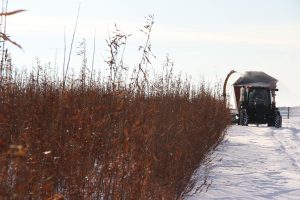
Willows are harvested near the Ohaton lagoon in Camrose County. Photo by David Dodge, Green Energy Futures
“We’re very excited about this project. We’re the first municipality to close the loop. We have a lot of municipalities coming to look at what we’ve done. And a lot of those municipalities that have come are implementing their own systems,” says Gerlitz.
Even the county reeve is on board.
“We believe that this kind of system helps a county gain control of its own fuel supply for heat and it also allows the opportunity to utilize effluent from our lagoons and utilize that material in a much better way than just releasing it into the environment,” says Don Gregorwich, the reeve for Camrose COunty.
“It’s much the same way in that people used to think of manure as a waste of time until we realized it was a tremendously valuable fertilizer. That’s what we have here.”
While this idea started in Europe it has taken the work of scientists like Krygier and progressive public servants like Gerlitz to bring this idea to Alberta. It’s a local, small-scale, appropriate solution for a wide swath of Canadian municipalities.
“I’m very optimistic that we’ll see this widely applied because we’re getting lots of interest from rural municipalities, small ones, that are looking for creative and innovative solutions to their problems,” says Krygier.
“A lot of them are farming communities, they know about growing things, they understand the potential and I think they see integration like Camrose County did between the wastewater treatment, the biomass production and an end use that gives them another opportunity in the end.”
It’s only by bringing it all together and considering the system as a whole that you really see the benefits. It’s not just the waste treatment, it’s also the savings on lagoon upgrades and improvements in water quality and biodiversity. It’s not just the biomass boiler, it’s the hedge against natural gas spikes and keeping jobs in the community.
Krygier is also enthusiastic about bio-ethanol and liquid fuels. Keep your eye on the humble willow, it might be capable of more than you might think.